1934 Bugatti Type 57 two-seat cabriolet
- Engine
- 3.3L inline-eight, dual overhead cam
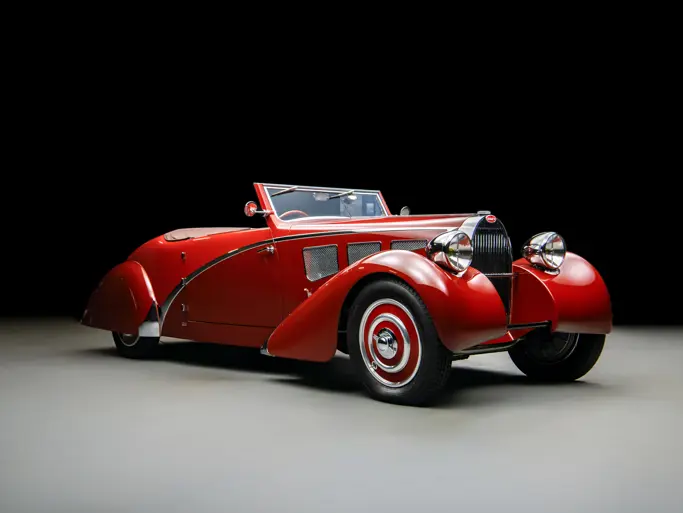
Chassis 57156 is among the earliest Bugatti Type 57s constructed, being the 56th example built and completed in late June 1934. Originally bodied as a four-door Galibier saloon, it was later re-bodied as a two-passenger cabriolet in Belgium, with coachwork of uncertain attribution. After decades of storage in the United States following disassembly, the car underwent a thorough restoration by California-based Bugatti specialist Alan Taylor, emerging in a restyled open configuration that earned multiple concours awards between 2013 and 2015.
Ownership
- —Auction saleSold US$759,000
- —Auction saleSold US$572,000
- —Auction saleSold US$665,000
- —Auction saleSold US$582,500
- 1934 → 1938-04-01Factory deliveryFrederic Deflandrefull documentation
Belgian mill owner and motorsport enthusiast; loyal Bugatti patron who returned the car to the factory in 1936 for mechanical upgrades and a chassis replacement before trading it in toward new coachwork on another Bugatti.
- 1938-04-01 →Private saleD'Ieterenpartial documentation
Belgian coachbuilder received the car as a trade-in from Deflandre; subsequently had a new two-seat cabriolet body fitted, identity of actual body builder unconfirmed.
- 1955 → 1955Private saleJean de Dobbeleerpartial documentation
Prominent marque dealer who acquired the car still bearing its original Belgian registration plates; sourced period-correct replacement rear axle and gearbox from other Type 57 donors.
- 1955 →Private saleJack Fritschepartial documentation
California-based Porsche dealer; car exported to the United States on his behalf by Gene Cesari.
- 1958 → 2003Acquisition unknownJoseph Finepartial documentation
Physicist at the National Bureau of Standards residing in Silver Spring, Maryland; began a restoration that stalled in the 1960s, after which the dismantled car sat in storage on his property until his death.
- 2003 →InheritanceJoseph Fine's widowpartial documentation
Inherited the car following her husband's passing and subsequently sold it to a collector.
- Date unknownAcquisition unknownAbbé Dubois de Sévrypartial documentation
Belgian priest who reportedly received the car as a gift from a Mr. Cadans and later traded it in; car remained in the Antwerp area during this period.
- Date unknownAcquisition unknownAl Wallpartial documentation
Intermediate US owner between Fritsche and Fine; no further details provided.
- Date unknownPrivate saleCharles Bronsonpartial documentation
Respected collector who purchased from Fine's estate and later resold the car.
- Date unknownPrivate salePaul Emplepartial documentation
Well-known Southern California collector who commissioned a comprehensive restoration by Bugatti specialist Alan Taylor in Escondido; actively exhibited the car at major concours events.
Competition
- 20132013 Amelia Island Concours d'EleganceMeguiar's Award
- 20132013 La Jolla Concours d'EleganceBest in Show Pre-War
- 20142014 Keels & WheelsPeople's Choice Award
- 20152015 Santa Fe ConcorsoBest in Class and Director's Award
- —Classic Car Club of AmericaClassic Car Club of America National JudgingFirst Prize
Maintenance & restoration
- 1936ModificationBugatti factory
The car was returned to the Bugatti factory, where the original body was moved onto a new second-series chassis fitted with a different engine; all original component numbers were restamped onto the replacement parts.
- 1938Bodywork
The Galibier saloon coachwork was removed and replaced by a new two-passenger cabriolet body with pontoon front fenders and an extended sweeping tail; the chassis was also updated with hydraulic brakes at this time.
Coachbuilder identity unconfirmed; candidates include Paul Nèe of Levallois-Perret and D'Ieteren of Belgium.
- —Mechanical
The rear axle and gearbox were replaced with period-correct units sourced from other Type 57 chassis, most likely during Jean de Dobbeleer's ownership in 1955.
Attribution to de Dobbeleer's tenure is the conclusion of historian Pierre-Yves Laugier based on inspection of mechanical stampings.
- —Restoration
Joseph Fine began a restoration of the car but left the project incomplete; the vehicle remained disassembled in storage for several decades.
Work commenced sometime after 1958 and was abandoned during the 1960s.
- —RestorationAlan Taylor
A thorough restoration addressing all mechanical and cosmetic aspects was carried out, including fabrication of new fenders, door skins, dashboard trim, and bonnet with shaped and plated vents. The body was restyled with brightwork character lines, skirted rear fenders, and a raised spine on the decklid, then finished in orange-brown paint. The interior was retrimmed in matching leather with bespoke luggage.
Commissioned by Paul Emple; workshop located in Escondido, California. The extended storage period had left the car in a dilapidated state requiring significant fabrication work.
Are you the owner of this car?
This car's public record is built from its auction and competition history. Register your ownership and privately add your own records to make it a verified Legacy Metrics passport — provenance that backs your car's value at sale and gives your insurer evidence to price against. Roy reviews and verifies every registration personally.