1913 Stutz Bearcat
- Engine
- 6.4L (390 cu in) T-head inline-four, ~60 bhp, fed by updraft carburetor
- Colour
- Dark green with red beneath the fenders
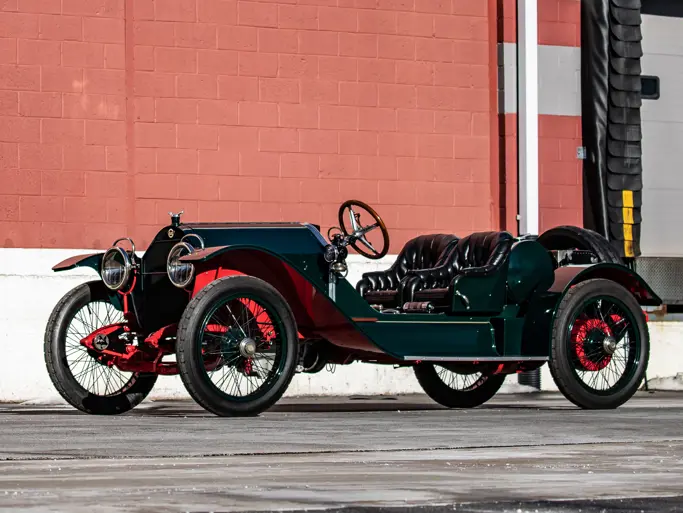
A 1913 Stutz Bearcat powered by a 390-cubic-inch Wisconsin T-head four-cylinder engine, the Bearcat was the road-going counterpart to the racing machine that famously completed the first Indianapolis 500 in 1911. Discovered as a partial wreck on a Montana ranch in the 1970s, the car was rescued by aerial surveyors and eventually underwent a full restoration in the early 2000s, with parts sourced from Harrah's, the Los Angeles County Museum, and private collectors. It now presents in dark green and red livery on Frayer knock-off wire wheels.
Ownership
- —Auction saleSold US$250,000
- 2000 → 2015Private saleCollector who undertook restorationpartial documentation
Purchased the car around the early 2000s and carried out a thorough restoration with his son, sourcing correct period components; the restoration story appeared in Stutz News in late 2009.
- 2015 →Private saleCurrent East Coast private collection ownerpartial documentation
Holds the car in a well-regarded private collection on the US East Coast; restoration has been carefully maintained during this ownership.
- Date unknownMontana ranch ownernone documentation
Vehicle sat on a ranch in Montana for an unknown period prior to discovery; only partial frame, engine, and fuel tank survived.
- Date unknownPrivate saleAerial surveyors who recovered the Stutzpartial documentation
Two aerial surveyors working in Montana discovered the car and negotiated its purchase from the ranch; held it in an incomplete state for years, doing some parts collection.
- Date unknownAcquisition unknownRestoration shop custodiannone documentation
By the early 2000s the car had moved to a restoration facility where it sat unrestored despite being somewhat more complete than at discovery.
Competition
- 19111911 Indianapolis 500Driver: Harry C. Stutzdid not win; completed 500 miles averaging approximately 62 mph
Prototype ran with only minimal mechanical adjustments and 13 pit stops, the majority for tires; durability was praised as exceptional for a first independent production entry.
Maintenance & restoration
- —Restoration
Following its discovery in Montana, the car was gradually assembled over many years by its then-owners, who sourced missing components but left it in an incomplete, unrestored state by the time it reached a restoration workshop.
Car sat at a restoration shop in an incomplete state as of the early 2000s.
- —Restoration
A thorough restoration was undertaken by a private collector and his son in the early 2000s, with period-correct parts sourced from Harrah's, the Los Angeles County Museum, and Paul Freehill, among others. The work was detailed in the Stutz News publication in the October–December 2009 issue.
Much of the labour was performed by the owner and his son personally over several years.
- —Modification
Several modernising upgrades were fitted to improve touring usability: the electrical system was converted to 12 volts, an electric starter was added, the ignition was changed from a magneto to a distributor arrangement with coils and points, and a contemporary clutch was installed.
Upgrades appear to have been made during or after the primary restoration.
Are you the owner of this car?
This car's public record is built from its auction and competition history. Register your ownership and privately add your own records to make it a verified Legacy Metrics passport — provenance that backs your car's value at sale and gives your insurer evidence to price against. Roy reviews and verifies every registration personally.