1956 Jaguar D-Type
- Engine
- 3.8L inline-six twin-cam, upgraded from original displacement, with 45mm Weber carburetors
- Colour
- British Racing Green (later refinished white)
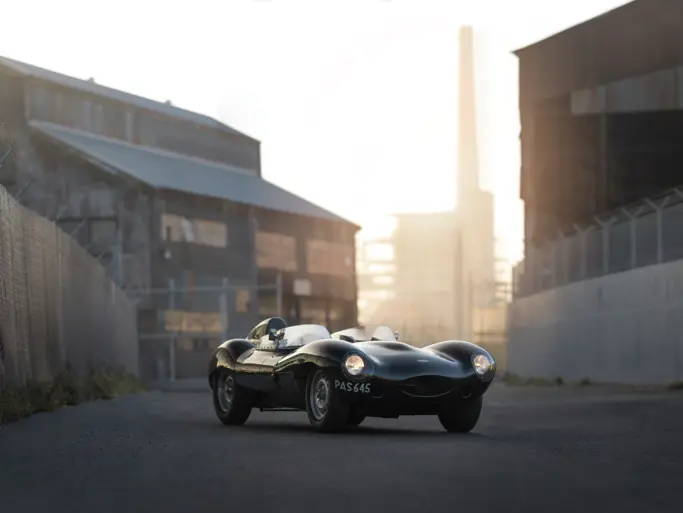
Jaguar D-Type chassis XKD 530 is one of fifty-four privateer customer cars built, dispatched from the factory in February 1956 in British Racing Green. Delivered to Finnish racing driver Curt Lincoln, the car competed extensively in Finnish circuit and ice racing under Scuderia Askolin, visited the Jaguar Works competition department for a major overhaul in 1959–60, and later raced at the 1961 Leningrad Grand Prix — believed to be the only D-Type ever to have competed in the Soviet Union. After decades of ownership changes, bodywork modifications, and a controversial split of components across two cars bearing the same chassis number, the original monocoque and chassis were definitively reunited and restored by CKL Developments in East Sussex, completed in mid-2003.
Ownership
- —Auction saleSold US$3,675,000
- —Auction saleEstimate US$5,500,000 – US$7,000,000
- 1956-04-01 → 1960Factory deliveryCurt Lincolnfull documentation
Helsinki-based Davis Cup tennis player and motorsport competitor who took delivery via Finnish Jaguar dealer S.M.K. Car was campaigned under the Scuderia Askolin banner; factory records reportedly show steps taken to obscure new-car status for import duty purposes.
- 1960 → 1966-11-01Private saleOlli Lyytikainenpartial documentation
Finnish magazine publisher who continued racing the car, frequently with Timo Makinen as driver, and entered it in the 1961 Leningrad Grand Prix.
- 1966-11-01 →Private saleNigel Moorespartial documentation
English collector and historic racing enthusiast who owned multiple D-Types. Found the car heavily worn with a modified open cockpit body; his staff removed the damaged bodywork, fitted new long-nose coachwork, and installed an engine formerly used by the Cunningham team. Original monocoque, engine, and gearbox were eventually sold around 1984.
- 1984 →Private saleJohn Harperpartial documentation
Historic racer who purchased the separated original monocoque body, engine, and gearbox from Moores, then mounted them on a newly constructed chassis using various original Jaguar factory components, creating a second car carrying the same chassis number.
- 1993 →Acquisition unknownArthur Urciuolipartial documentation
Acquired the car built around the original monocoque body; referenced in a 1995 letter from Ole Sommer addressing the dual-identity controversy.
- 1998 →Acquisition unknownPrevious owner (consignor)full documentation
Acquired one version of the car in 1998 and the second in mid-2002, then commissioned CKL Developments to disassemble both, identify and sort original components, and reunite the original monocoque with its correct chassis frame, completing restoration by mid-2003.
Competition
- 19541954 Le Mans 24 Hours2nd overall
D-Type's race debut; finished narrowly behind a large-displacement Ferrari V-12. Not specifically this chassis — general model history context.
- 19561956 Elaintarhanajo (later round)Driver: Curt Lincoln1st in class
Lincoln competed alongside his C-Type, which he had lent to Vaino Miettinen for the same event.
- 1956-05-101956 ElaintarhanajoDriver: Curt Lincoln1st in class
Raced under the Scuderia Askolin banner with a raised final drive ratio on the Helsinki city circuit.
- 19571957 Elaintarhanajo
Mentioned as one of the last circuit events before the car shifted primarily to ice racing.
- 1957-02-24Ice raceDriver: Curt Lincoln1st
Tires fitted with large spikes for ice conditions; one of two consecutive ice race victories that winter.
- 1957-03-10Ice raceDriver: Curt Lincoln1st
Second ice race win of the season; car was subsequently repainted in Scuderia Askolin's white and dark blue livery.
- 19581958 competitive seasonMultiple 1st and 2nd place finishes
Car had been modified by Helsinki coachbuilder Wiima with a full-width screen, new door, and custom tail fin prior to this season.
- 1960-02-01Ice racesDriver: Curt LincolnTwo victories
Contested following the factory overhaul in Coventry; engine replaced with a 3.8-liter unit and car returned with noted power increase.
- 1961-08-27Leningrad Grand PrixDriver: Heimo Hietarinta1st in Formula Libre class
Believed to be the only D-Type ever raced on Soviet soil; the event was covered in a Finnish magazine the following month. Car was then owned by Olli Lyytikainen.
Maintenance & restoration
- 1956ModificationJaguar factory
Factory took steps to make the car appear pre-used before delivery: pedals were brushed to simulate wear, the steering wheel was swapped for a used example, and the odometer was adjusted — all to help the importer avoid Finnish new-vehicle duties.
Carried out on Lincoln's instruction prior to dispatch; confirmed by factory documentation.
- 1956Mechanical
Final drive ratio increased to 3.54:1 for circuit racing use.
- 1957Modification
Tyres fitted with 1¾-inch metal spikes to allow ice racing; car later repainted in Scuderia Askolin white and dark blue team livery.
- 1958BodyworkWiima
Coachbuilder Wiima of Helsinki installed a full-width windscreen, a new nearside door, and a custom tail fin to bring the car closer to GT class configuration.
Work was carried out domestically after Lincoln decided against a full XK-SS conversion.
- 1959Engine rebuildJaguar Works competition department
Engine block replaced with a factory 3.8-litre unit; 40 mm Weber carburettors exchanged for 45 mm items; gearbox and brakes were reconditioned; car repainted white.
Car arrived at the factory in December 1959 following Lincoln's May 1959 letter to Lofty England noting that ice racing had caused significant wear. Returned with a note indicating a 100 hp power increase.
- 1984Restoration
John Harper repaired the original monocoque bodywork and mounted it on a newly constructed chassis composed largely of original Jaguar factory components, creating a second car also carrying the XKD 530 number.
- 2002RestorationCKL Developments
Both cars bearing the XKD 530 identity were fully disassembled by CKL Developments; individual parts were catalogued against original factory part numbers, colour-coded to identify which were genuine XKD 530 components, and the authentic original monocoque was then remounted on the original chassis frame — verified by the precise alignment of non-uniformly drilled factory bolt holes. Restoration completed mid-2003.
Work was commissioned by the previous owner after acquiring both cars (1998 and June 2002); the process was documented in a five-part series in Jaguar World Monthly, December 2002 to September 2003.
- —Bodywork
After acquisition by Nigel Moores, staff removed the worn and modified body, fitted entirely new long-nose style bodywork, and installed a wide-angle headed engine sourced from the Cunningham team.
Original monocoque, engine, and gearbox were retained separately and later sold around 1984.
Are you the owner of this car?
This car's public record is built from its auction and competition history. Register your ownership and privately add your own records to make it a verified Legacy Metrics passport — provenance that backs your car's value at sale and gives your insurer evidence to price against. Roy reviews and verifies every registration personally.