1963 Aston Martin DP215 Design Project
- Engine
- 4.0L inline-six twin-plug, dry sump, triple Weber carburetors, ~300–326 bhp
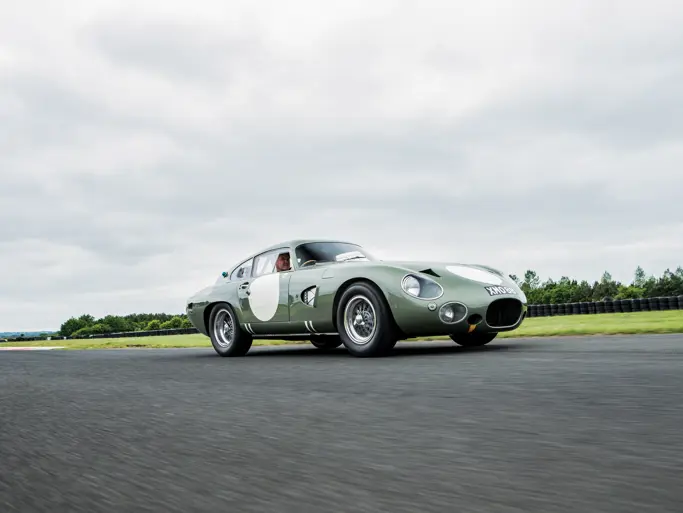
The Aston Martin DP215 is the last racing car constructed by the Aston Martin factory, representing the pinnacle of the company's GT racing programme derived from the DB4GT. Designed by Ted Cutting, powered by a four-litre twin-plug six-cylinder engine, and driven by Phil Hill and Lucien Bianchi at the 1963 Le Mans 24 Hours, it was the first car to officially exceed 300 kph on the Mulsanne Straight. Retired from racing after two DNFs, it was kept by Aston Martin for development before an accident on the M1 ended those plans. Sold in 1974, it passed through several custodians engaged in a long-term restoration aimed at returning the car to its original specification.
Ownership
- —Auction saleSold US$21,455,000
- 1963 → 1974Factory deliveryAston Martin (factory)partial documentation
After closing the racing department, the factory retained DP215 for potential future development, until an accident on the M1 motorway during night testing ended those plans.
- 1974 → 1978-04-01Private saleMalcolm Calvertfull documentation
Calvert, from the Isle of Wight, began a road-use restoration, fitting a DB6 engine and ZF gearbox. Photos document the car's condition when collected from Aston Martin. He used the car on public roads before selling it.
- 1978-04-01 →Private saleNigel Dawespartial documentation
Noted Aston Martin collector who pursued a thoroughgoing historical restoration, collaborating with original designer Ted Cutting and sourcing a period Indianapolis Cooper-Aston engine reworked to dry-sump specification by Forward Engineering.
Competition
- 19621962 Le Mans 24 HoursDriver: Graham Hill5th on grid (retired or unclassified implied)
Car contested was DP212, co-driven by Richie Ginther and Graham Hill; rear-end lift at speed was a major handling issue encountered during the race weekend.
- 19631963 Le Mans 24 HoursDriver: Phil HillDNF — gearbox failure
Co-driven by Lucien Bianchi; DP215 set a landmark by breaking 300 kph on the Mulsanne Straight in practice, but retired after approximately two hours when the CG537 gearbox failed under high torque.
- 19631963 Reims raceDriver: Jo SchlesserDNF — engine over-rev
DP215 was leading when a transmission issue caused a missed gearchange, resulting in engine over-revving and forced retirement.
- 19631963 Brands Hatch Guards TrophyDNS
DP215 was entered but tax regulations prevented David Brown from actually racing the car.
- 19631963 Monza GT race (Italian GP support)Driver: Roy Salvadori1st (class or overall in support race)
A DP214 driven by Salvadori defeated the Works Ferrari 250 GTO of Mike Parkes in the three-hour support race at Monza.
Maintenance & restoration
- 1963Repair
Gearbox repaired following the Le Mans retirement; the car was made ready for the Reims entry the following month.
- 1963Modification
S532 gearbox — the unit originally specified for the car — was fitted in place of the CG537 unit used at Le Mans.
- 1974RestorationAston Martin
Aston Martin factory fitted the original 1963 Works DP214/215 spare body onto the slightly damaged chassis; many unique original components including suspension, rear differential, dashboard, instruments and pedals were retained.
Work carried out at the factory prior to or at the time of sale to Malcolm Calvert.
- —Repair
Chassis sustained damage in a night accident on the M1 motorway during development testing.
Occurred after the racing department closed; exact date not recorded in the prose.
- —Modification
A DB6 engine and ZF gearbox were installed in place of the original competition drivetrain to allow road use.
Fitted during Malcolm Calvert's ownership; original four-litre engine had previously been sold to privateer Colin Crabbe for use in a DP214.
- —RestorationForward Engineering
Ongoing authenticity-focused restoration undertaken in consultation with original designer Ted Cutting, including sourcing a period-correct engine; a 4.2-litre Indianapolis Cooper-Aston unit was obtained and converted to dry-sump specification by Forward Engineering to approximate the original configuration.
Carried out during Nigel Dawes's ownership; the original four-litre engine was located in a DP214 but had been converted to wet sump, so an alternative period unit was used with Cutting's approval.
Are you the owner of this car?
This car's public record is built from its auction and competition history. Register your ownership and privately add your own records to make it a verified Legacy Metrics passport — provenance that backs your car's value at sale and gives your insurer evidence to price against. Roy reviews and verifies every registration personally.