1971 Ferrari 365 GTB/4 Daytona Competizione
- Engine
- V12, over 450 bhp with Traco modifications including high-compression pistons and heads, dry-sump lubrication
- Colour
- Red with blue and white racing stripes over Marathon Oil livery
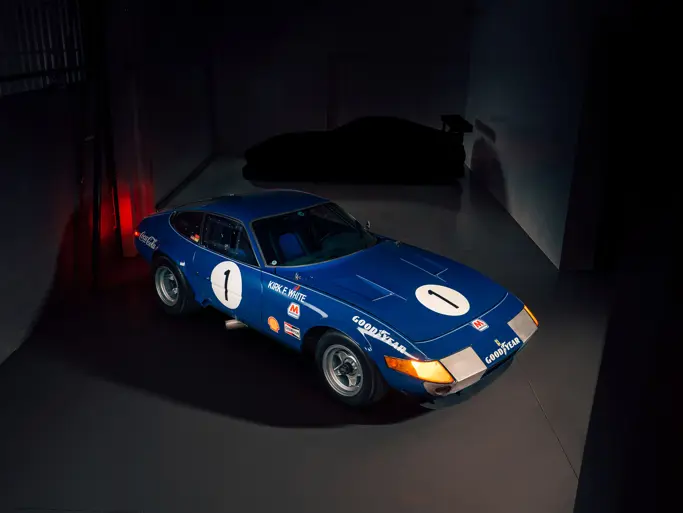
Chassis 14065 is a 1971 Ferrari 365 GTB/4 Daytona delivered new to Luigi Chinetti Motors and subsequently prepared by Holman-Moody for the 1972 12 Hours of Sebring, where it was driven by David Hobbs and Skip Scott. Equipped with a Traco-engineered V-12 producing over 450 hp and extensively modified with GT40 brakes, flared aluminium arches, and a dry-sump lubrication system, it is considered by many specialists the most powerful Daytona Competizione ever built. The car later received a sympathetic period-correct restoration by DK Engineering and won the Finest Competition Car award at the 2010 Cavallino Classic.
Ownership
- —Auction saleEstimate US$2,250,000 – US$2,750,000
- 1971 → 1971Private salePeter Kalikowpartial documentation
Noted Ferrari collector who returned the car shortly after purchase for unspecified reasons.
- 1971 → 1972Private saleRon Spanglerpartial documentation
Maryland-based marque enthusiast known for his Prancing Horse Farm; agreed to temporarily transfer the car to Kirk White for a racing campaign with a buyback arrangement.
- 1971-03-01 → 1971Factory deliveryLuigi Chinetti Motorsfull documentation
New distributor delivery in the US; original factory invoice and Chinetti Motors bill of sale are among the documented records.
- 1972 → 1972Private saleKirk F. Whitepartial documentation
Pennsylvania-based Ferrari racing specialist who arranged extensive competition preparation through Holman-Moody and Traco; returned the car to Spangler after the Sebring campaign ended with a DNF.
- 1972 →Private saleRon Spanglerpartial documentation
Exercised the pre-agreed buyback after the racing season; held the car before it passed through several collector and dealer hands over roughly two decades.
- Date unknownAcquisition unknownSwiss collectorpartial documentation
Acquired the car during the middle of the 1980s; obtained FIA papers and had the car repainted red with blue and white racing livery stripes.
- Date unknownAcquisition unknownBruce Zieglerpartial documentation
California-based collector who owned the car toward the end of the 1980s; presented it at several Ferrari Club of America events during his tenure.
- Date unknownAcquisition unknownJapanese enthusiastpartial documentation
Owned the car for roughly ten years starting in the middle of the 1990s before selling it onward to Canada.
- Date unknownPrivate saleLorne Leibelpartial documentation
Ontario, Canada-based owner who had engine work carried out by Ferrari of Ontario and showed the car at the 2010 Cavallino Classic, earning a concours award.
- Date unknownAcquisition unknownCurrent consignorfull documentation
Commissioned a sympathetic restoration to period Competizione specification by DK Engineering in the UK, including mechanical refreshment; assembled extensive documentation file.
Competition
- 19721972 12 Hours of SebringDriver: David HobbsDNF — driveshaft bolt failure, lap 53
Co-driven by Skip Scott; car ran Traco-modified engine in Marathon Oil livery with Coca-Cola branding. Retired roughly three hours into the race when overpowered engine sheared factory driveshaft bolts.
- 2010Cavallino Classic2010 Cavallino Classic Sunday Concours d'EleganceFinest Competition Car award
Presented by owner Lorne Leibel at Mar-A-Lago; Ferrari Classiche subsequently issued a historic-interest classification shortly afterward.
Maintenance & restoration
- 1971Engine rebuildTraco
The original V-12 was swapped for engine no. B 1018 from the Cannonball Daytona (chassis 14271) and sent to Traco in California for modifications mirroring those on the 512 M, including high-compression pistons and cylinder heads, a dry-sump lubrication system, and revised ignition timing and carburettor jetting.
Traco was chosen based on its prior work on the Ferrari 512 M campaign run by Kirk White and Roger Penske.
- 1971RestorationHolman-Moody
Holman-Moody prepared the car for endurance racing: fitted an aluminium radiator, wider wheels (9-inch front, 11-inch rear), GT40 Mk IV brakes with 12-inch rotors and four-piston iron calipers, a rollbar, and a competition instrument cluster. An Indy car fabricator crafted hand-formed aluminium flared wheel arches and a front spoiler; bumpers were removed, cooling vents cut out, and an external centre fuel filler was added through the rear decklid. Dynamometer testing recorded over 450 hp.
Holman-Moody was selected on the strength of their Ford GT40 programme experience and NASCAR pedigree.
- —MechanicalFerrari of Ontario
Engine work carried out by Ferrari of Ontario during Lorne Leibel's ownership.
- —InspectionFerrari Classiche
Ferrari Classiche examined the car and issued a 'white book' certifying it as a Daytona Competizione of historic interest.
Certification was issued a few months after the 2010 Cavallino Classic appearance.
- —RestorationDK Engineering
DK Engineering carried out a sympathetic restoration returning the car to correct period Competizione specification, accompanied by a thorough mechanical refresh. A correct-type replacement engine was installed; the original Traco-built block is retained separately.
Commissioned by the current consignor; DK's James Cottingham also recorded an interview with the late Kirk White to document the car's history.
Are you the owner of this car?
This car's public record is built from its auction and competition history. Register your ownership and privately add your own records to make it a verified Legacy Metrics passport — provenance that backs your car's value at sale and gives your insurer evidence to price against. Roy reviews and verifies every registration personally.