1930 Alfa Romeo 6C 1750 Gran Sport
- Engine
- 1.752L supercharged DOHC inline-six, 85 bhp
- Colour
- Dark red
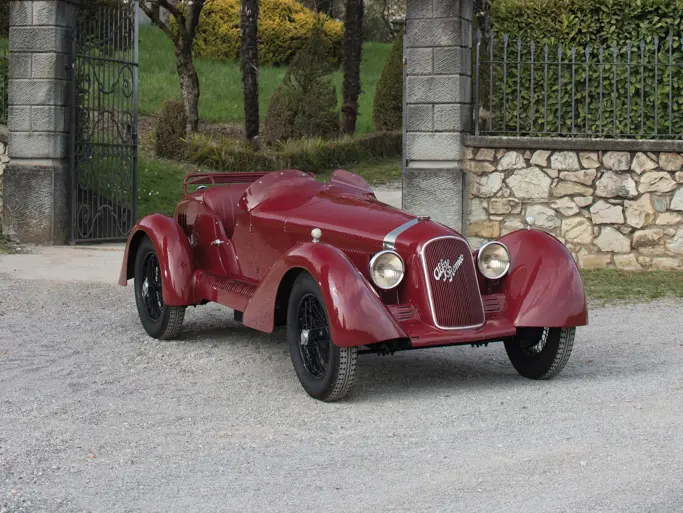
Chassis 8513048 is a 1930-series Alfa Romeo 6C 1750 Gran Sport, one of approximately 106 examples built with the Roots-supercharged 85 bhp engine. Originally sold to the Italian Ministry of Agriculture in Rome, it was campaigned by Professor Mario Ferraguti in the 1931, 1933, and 1936 Mille Miglia — notably as a gasogeno (wood-gas) demonstration vehicle in the latter two entries. The car now carries period-style pontoon-fendered coachwork and forms part of the Count Agusta Collection.
Ownership
- —Auction saleEstimate €900,000 – €1,200,000
- 1930 →Factory deliveryItalian Ministry of Agriculture, Romepartial documentation
The vehicle was sold directly to a government ministry in Rome upon or shortly after its production.
- Date unknownAcquisition unknownProfessor Mario Ferragutipartial documentation
Ferraguti served as Director of a horticultural research institute near Rome and entered the car in multiple Mille Miglia events; he also had the vehicle converted to run on gasogeno fuel and operated it under his company, Societa Autogasogeni Ferraguti.
- Date unknownAcquisition unknownCount Agusta Collectionpartial documentation
The car was held in this prominent private collection prior to being consigned for auction; the collection is described as renowned.
Competition
- 1931Mille Miglia1931 Mille MigliaDriver: Mario FerragutiDNF
Ferraguti drove alongside co-driver Femminini; the car ran in standard (non-gasogeno) form and failed to reach the finish.
- 1933Mille Miglia1933 Mille MigliaDriver: Mario FerragutiFinished outside time limit
Car entered as a demonstration of gasogeno alternative fuel technology; co-driver was Augusto Agostini, a Forestry Militia general. Average speed was roughly 32 mph versus the winner's near 68 mph; reportedly required three attempts to climb a hill between Perugia and Gubbio.
- 1936Mille Miglia1936 Mille MigliaDriver: Mario FerragutiDNF
Entered in a special alternative-fuel class alongside five other gasogeno or non-standard-fuel cars; co-driver was Vacchini. Of the six alternative-fuel entrants, only one Fiat managed to complete the course.
Maintenance & restoration
- —Modification
The car was converted to operate on gasogeno — a wood or coal gas fuel system — requiring significant modifications to the fuel and intake systems. The conversion apparatus was incorporated into the bodywork, typical of the period practice of using a large rear blister or trailer unit.
Conversion took place sometime after the 1931 Mille Miglia and before the 1933 entry, driven by fuel scarcity during the economic depression.
- —Bodywork
The car was fitted with its current period-style body featuring pontoon fenders, cut-down doors, and a dark red finish with pleated leather interior. The precise date of this coachwork change is not recorded, though it is consistent with period design.
The styling bears resemblance to both the Alfa Romeo 8C 2300 and the Squire sports car; the change may relate to work Ferraguti was undertaking on a separate 8C 2300 around 1936.
Are you the owner of this car?
This car's public record is built from its auction and competition history. Register your ownership and privately add your own records to make it a verified Legacy Metrics passport — provenance that backs your car's value at sale and gives your insurer evidence to price against. Roy reviews and verifies every registration personally.