1924 Hispano-Suiza H6C 'Tulipwood' Torpedo (Nieuport-Astra coachwork)
- Engine
- 8.0L overhead-cam inline configuration
- Colour
- Varnished mahogany wood (natural finish with orange stain and clear outer coat)
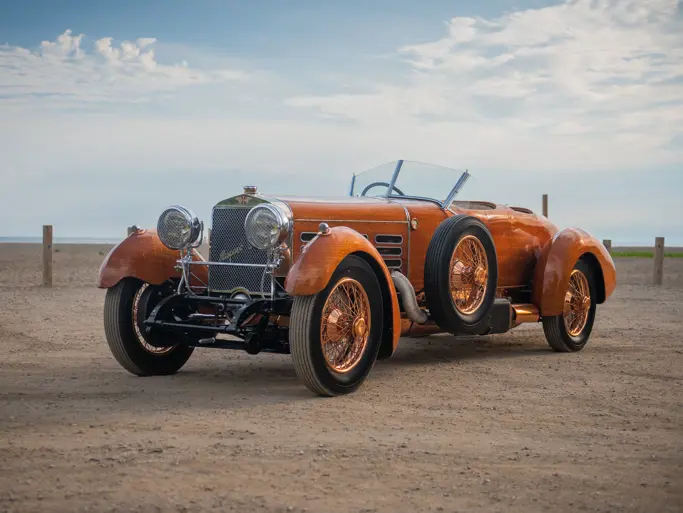
The Hispano-Suiza H6C 'Tulipwood' Torpedo is one of the most celebrated automobiles of the 1920s, commissioned by aperitif heir and aviator André Dubonnet on a factory-lowered surbaissé chassis and bodied by aircraft manufacturer Nieuport-Astra in delicate mahogany strips over aluminium rivets, weighing a reported 160 pounds. Dubonnet drove it to 6th overall in the 1924 Targa Florio and 5th in the accompanying Coppa Florio before the car passed through several distinguished hands, including marmalade heir and archaeologist Alexander Keiller and Standard Oil heir Gerald Albertini, who undertook a careful restoration supervised by noted Hispano-Suiza technician George Briand.
Ownership
- —Auction saleSold US$9,245,000
- 1924 → 1925Factory deliveryAndré Dubonnetfull documentation
Took delivery of one of only three factory-lowered H6C chassis; used the car for competition and subsequently adapted it for road use with additional bodywork details.
- → 1925Acquisition unknownRoland Cotypartial documentation
Believed to be the perfume magnate's son and a noted enthusiast of Hispano-Suiza automobiles; tenure was brief.
- 1925 → 1950Private saleAlexander Keillerfull documentation
Scottish marmalade heir and archaeologist who registered the car in London and had coachbuilder Barker add flowing open fenders and other trim; eventually placed the car in storage in Plymouth, where it sustained minor war damage.
- 1950 → 1956Private saleRodney Forestier-Walkerfull documentation
Acquired the car after meeting with Keiller; patched war damage with plywood, modified the windscreens, and replaced the original headlights; wrote about his experiences with the car in a published article.
- 1956 →Private saleGerald Albertinifull documentation
Standard Oil heir based in London who approached the previous owner via a note left on the windscreen; undertook a substantial mechanical and coachwork restoration, including new wooden fenders crafted by a boat-builder named Harry Day and an interior fitted in cream leather.
Competition
- 1924-04-271924 Targa FlorioDriver: André Dubonnet6th overall
Car carried Paris registration 6966-I6; described as among the largest entrants on the circuit, yet remained competitive despite persistent tyre difficulties.
- 1924-04-271924 Coppa FlorioDriver: André Dubonnet5th overall
Completed an additional lap on the Madonie circuit after the Targa Florio, running approximately eight and a half hours total; tyre misfortune continued to hamper the effort.
Maintenance & restoration
- 1950Modification
Forestier-Walker modified both the front and rear windscreens and replaced the original Blériot headlights with Lucidus units.
- —Modification
Car adapted from competition to road specification with the addition of flat open fenders, a low windscreen, a small door, headlights, and a large passenger-side searchlight.
Changes are documented in a period photograph of Dubonnet with the car.
- —ModificationBarker
During Keiller's ownership, the car received flowing open fenders later replaced by cycle-style wings, a cover over the rear seat, what appears to be a replacement exhaust system, and various minor trim alterations; the flowing fenders are attributed to coachbuilder Barker.
Attribution to Barker is based on the firm's name found on original photographs held in the Nethercutt Collection library, and stylistic similarity to other Barker-bodied cars of the period.
- —Repair
Wartime bomb-splinter damage to the tail was noted; the tail was subsequently patched with plywood by Forestier-Walker when he acquired the car in 1950.
Initial damage occurred during storage at a Plymouth coachbuilder's premises; the plywood repair was a temporary measure under Forestier-Walker's ownership.
- —Engine rebuild
Mechanical components overhauled under the supervision of noted Hispano-Suiza specialist George Briand; the car was reported to have covered just over 17,000 miles and showed minimal wear apart from the clutch.
Work commissioned by Gerald Albertini following his acquisition of the car circa 1955–1956.
- —Modification
A smaller-diameter steering wheel was fitted and the driving seat repositioned to suit Albertini's frame, requiring installation of a longer, cranked external gear lever.
- —RestorationPanelcraft of Putney
Coachwork restored by Panelcraft of Putney: war-damaged timber replaced with new wood, copper plating applied throughout, and the interior retrimmed in cream leather. The cycle-style fenders were replaced by bespoke wooden torpedo-style wings hand-crafted by elderly boat-builder Harry Day, each comprising a hand-beaten alloy shell skinned in steam-formed polished wood secured with matching aluminium rivets.
The distinctive fenders were made to Albertini's commission by Harry Day, who applied traditional boat-building techniques to produce units that closely matched the mahogany aesthetic of the main body.
Are you the owner of this car?
This car's public record is built from its auction and competition history. Register your ownership and privately add your own records to make it a verified Legacy Metrics passport — provenance that backs your car's value at sale and gives your insurer evidence to price against. Roy reviews and verifies every registration personally.